List of Government Design Systems
A design system is a collection of reusable components / standards that aid in digital product design & development.
Or, how I prepared for and passed the AWS Certified AI Practitioner exam in less than a week.
Getting cloud certifications can feel daunting, especially with the newer AI-focused ones. Here’s how I prepared for and passed the AWS Certified AI Practitioner exam with less than 20 hours of study time spread across a week.
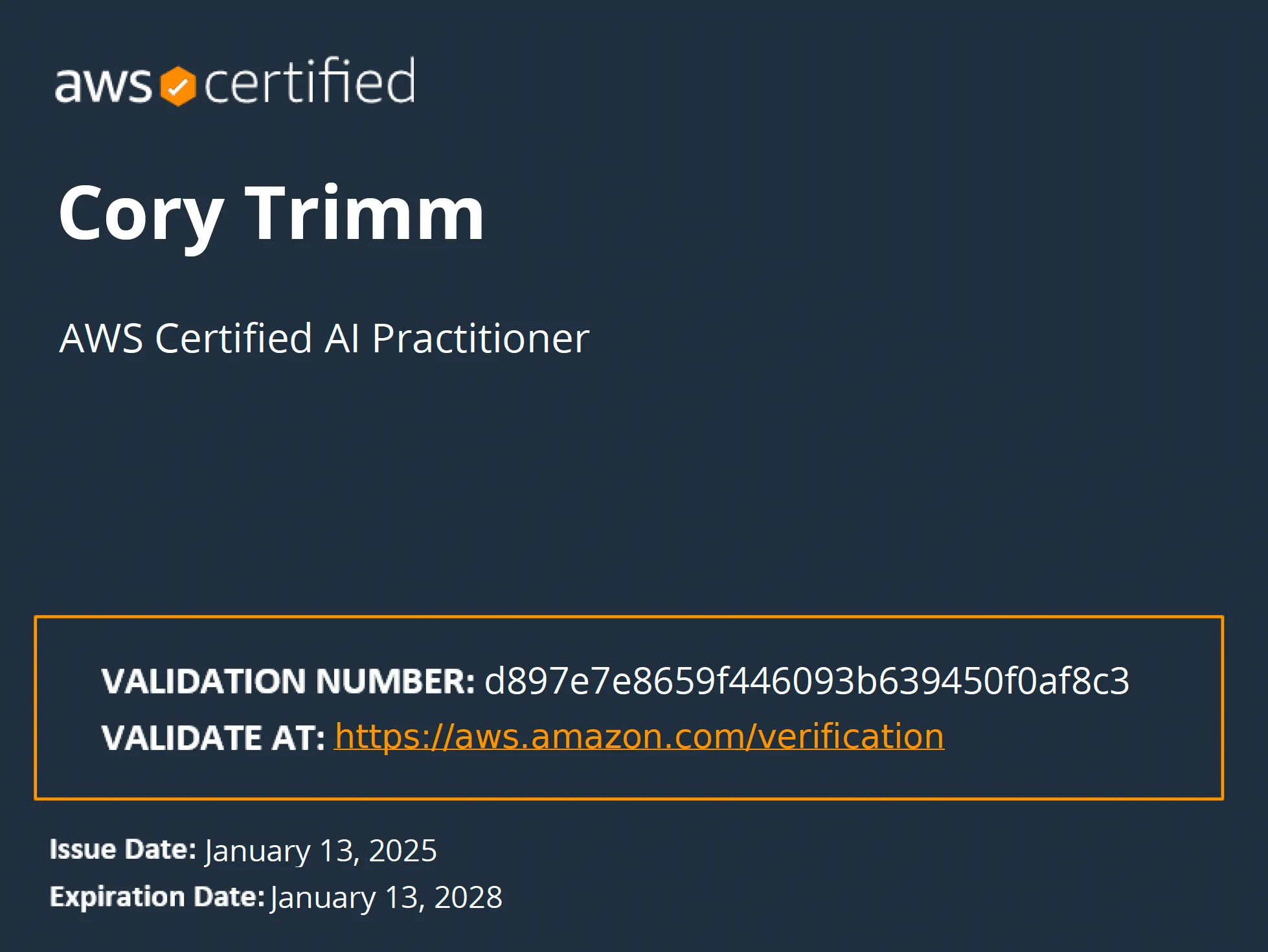
This cert has been in Beta for a little bit now (circa late 2024) - however, I let the various promos for getting the cert for free pass me by while building various projects with AWS and AI. From my CO2 emissions tracker to training AI models for Backyard Sports characters to implementing practical AI applications and exploring federal AI use cases, these hands-on experiences with AWS services proved invaluable. My experience with AWS deployments and Lambda functions helped provide a solid foundation.
This is a Foundational Certification - so, if you have another AWS Associate, Professional or Specialty certification, you will be familiar with the test format, some core AWS Services (S3, EC2, IAM, etc.) that help expedite the study timeline. Hopefully my brief Study Guide for the AWS AI Certified Practitioner Exam below will help you quickly pass too.
The current version of the exam (AIF-C01) consists of 65 questions. And it includes some new question types that differ from traditional AWS certifications. This actually worked in my favor as I found that many of the practice exam questions focused on practical applications rather than just memorizing service features.
Unlike traditional certification paths where you might spend weeks or months preparing, I took a focused, minimal approach. This is because I had a free retake if I failed (thanks to a coupon) and I was very familiar with AI/ML/DL/GenAI terminology + implementations. Here’s what worked for me:
Review the AWS Certified AI Practitioner Exam Guide
Complete the following AWS SkillBuilder’s Free Courses in Step 2:
Christian Greciano’s AIF-C01 Study Notes - an invaluable resource for understanding service comparisons
Quizlet flashcards (used only for last-minute review)
More on the AWS AI Certified AI Practitioner Certification Here
The key was combining AWS’s official learning materials with strategic third-party resources. While AWS SkillBuilder courses provided the foundation, Christian Greciano’s study notes proved invaluable for understanding real-world applications and service comparisons.
If I think of more items, I’ll add them to the list above.
These question types and study areas are heavily outlined in the exam guide materials. If this is your first ever AWS Certification, be sure to take more practice exams to get used to the question style. There is usually a keyword or two to focus in on to help inform your answer(s).
The results of the exam are stated to arrive within a few days. However, I received mine the same day - took the test at a local test center around 9am local time with results arriving by email around 4pm local time. I am unsure how long it takes to receive the results if you take a remotely proctored exam.
Note: Unlike the Cloud Practitioner exam, you won’t get a PASS/FAIL result immediately after completing the test. Results typically arrive within 5 business days. (Note - mine arrived ~6 hours after finishing)
Use the Flagging feature of the exam software was beneficial for marking questions to return to. Be sure to check in on how much time you have remaining. I was able to go thru all of the questions at least 2 times - while reviewing the ones I was unsure on a few times.
One of the most crucial aspects of the exam is understanding which AWS service is best suited for specific scenarios. It’s not enough to know what each service does - you need to understand:
I found that creating comparison tables and decision trees helped solidify this knowledge. The day before the exam, I used Quizlet flashcards to reinforce these service selection scenarios, which proved to be a highly effective last-minute review strategy.
While preparing for this exam, I made handwritten notes and printed off pages from AWS documentation - despite having all materials available digitally. After taking a practice exam, I would also write down why a question was incorrect or other pieces of info I would learn from the explanations for the correct / incorrect answers.
This wasn’t just personal preference - it’s backed by cognitive science.
Research published in “Psychological Science” found that students who took handwritten notes performed better on conceptual questions compared to those who typed their notes. Another study pulushed in “Frontiers in Psychology” demonstrated that writing by hand helps promote learning (Van der Weel FRR, Van der Meer ALH., 2024).
If you’re planning to pursue more AWS certifications, this serves as a solid foundation for the ML Associate or ML Specialty Cert. The knowledge gained from just this exam has proven to be particularly valuable in my projects, from building AI-powered applications to understanding enterprise AI implementations.