Before I Begin: The views represented here are my own and have never been views of my past employer(s). Last Updated: March 2025
The 2024 Federal AI Use Cases Inventory: What’s Really Happening
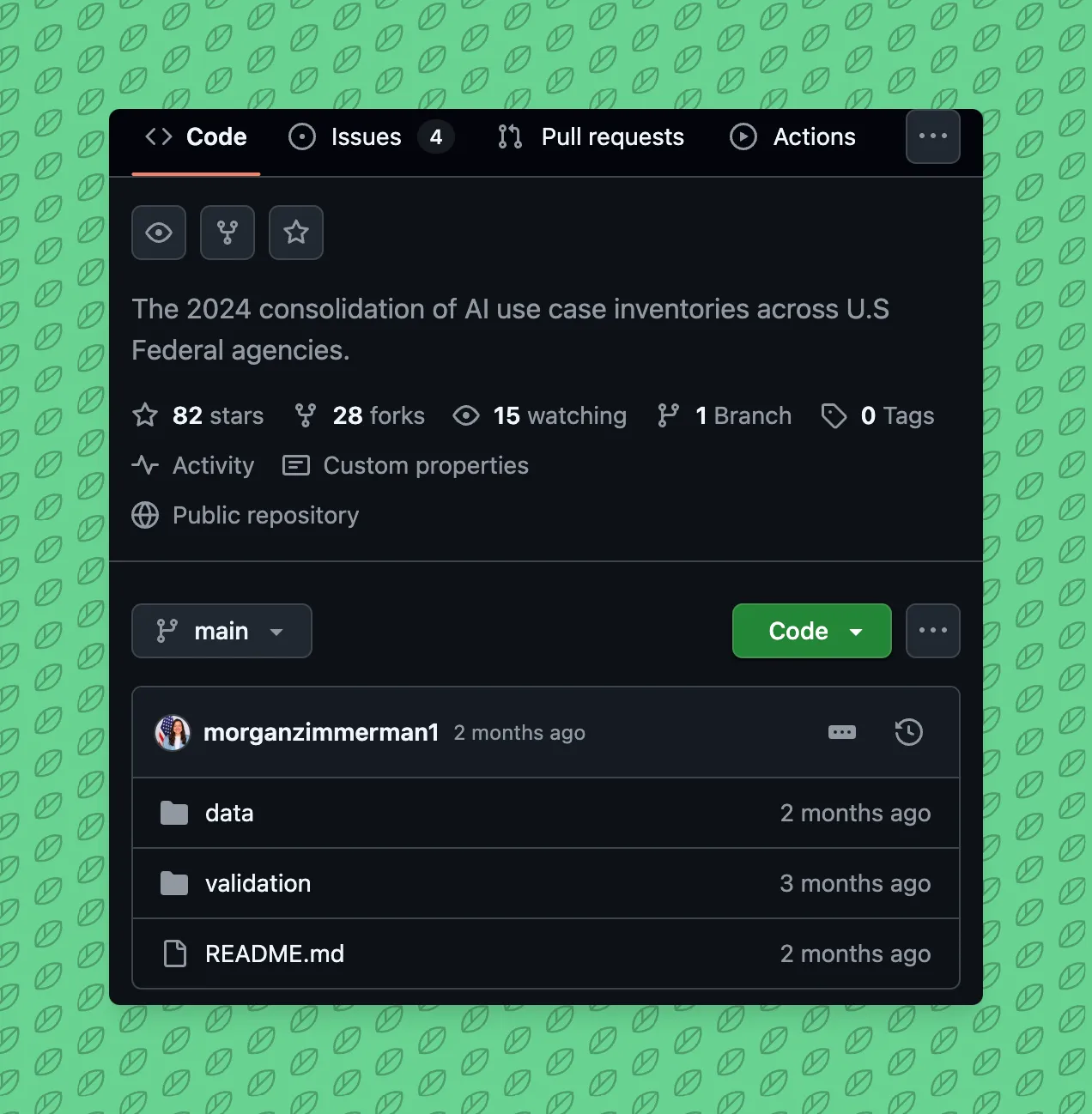
The White House recently released the 2024 Federal AI Use Cases Inventory, and it’s massive: 2,133 AI use cases across 41 federal agencies. According to FedScoop, that’s a big jump from last year’s inventory, though exact previous numbers are a bit murky.
One thing to note: this inventory was completed under Executive Order 14110 on Safe, Secure, and Trustworthy AI, which was rescinded on January 20, 2025. The regulatory picture around federal AI is in flux, but the inventory still tells you a lot about how agencies were approaching AI adoption.
I’ve spent time in government tech and have worked on government design systems and tracked federal website performance, so I was curious to dig into this data and see what’s actually happening.
The big picture: who’s using AI and how?
Some high-level findings that jumped out at me:
- Department of Health and Human Services (HHS) leads with 271 AI use cases
- Department of Veterans Affairs (VA) follows with 229 use cases
- Department of Justice (DOJ) has 240 use cases
- Department of Homeland Security (DHS) reports 183 use cases
What’s most interesting to me is which agencies are investing heavily in “rights-impacting” or “safety-impacting” AI applications. The inventory shows 351 such use cases, with the VA accounting for 145 of them and the DOJ reporting 124. That makes sense given these agencies’ missions directly affect benefits, law enforcement, and health services.
Types of AI being deployed
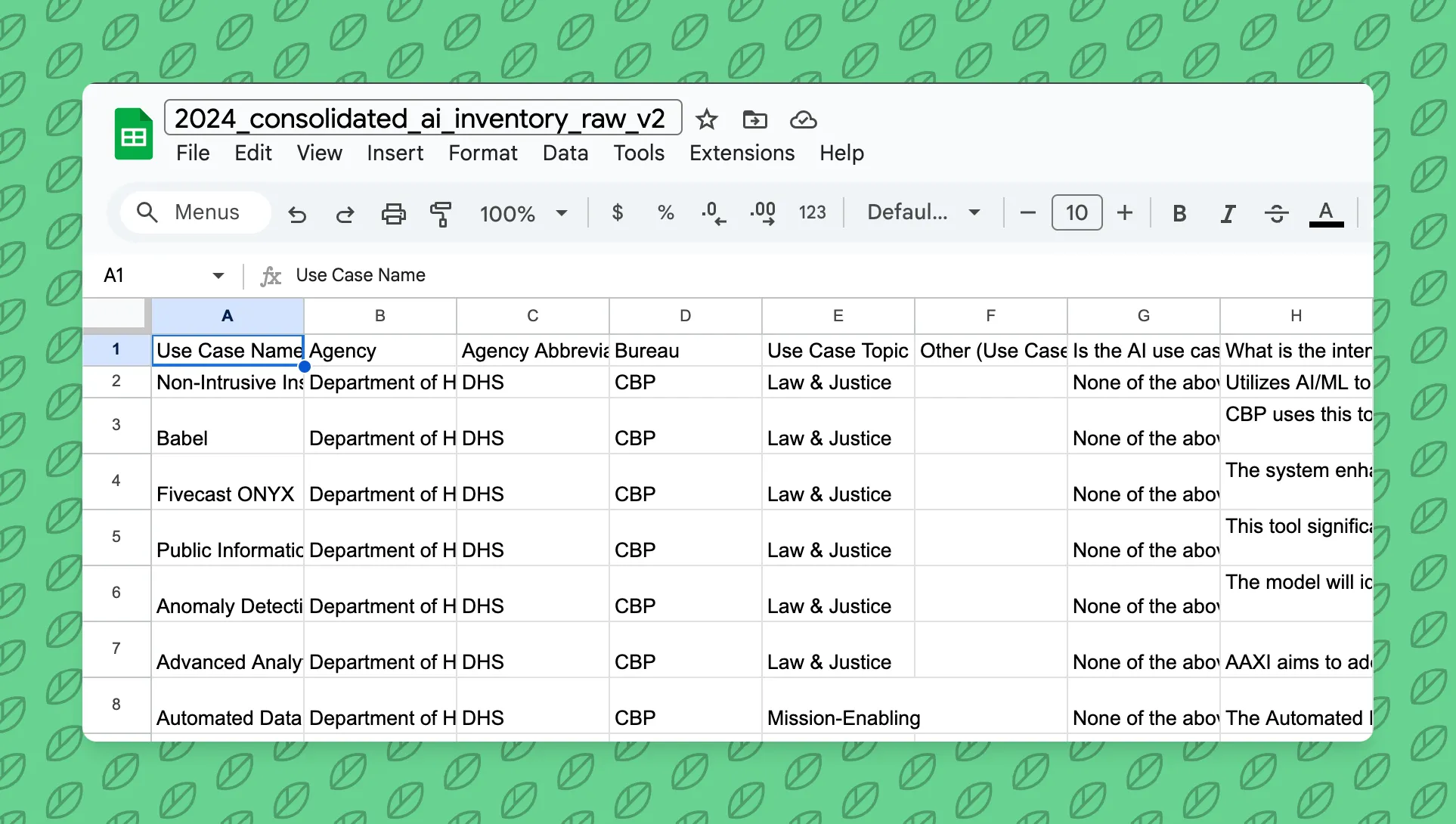
The top three categories were mission-enabling (internal agency support), health and medical, and government services (benefits and service delivery).
This tracks with what I’ve seen in government. The first wave of AI adoption usually focuses on internal productivity before moving to citizen-facing applications.
The reality check: many are still in development
Something important to note: not all these AI use cases are currently active. The inventory includes use cases at various stages:
- Initiated (planning phase)
- Acquisition and/or Development
- Operation and Maintenance (actually being used)
- Some have even been retired
In my experience working on government tech initiatives, there’s often a significant gap between planning a technology implementation and having it fully operational. I’d be curious to know exactly how many of these 2,133 use cases are actually in production today.
Risk management challenges
One of the most revealing aspects of the inventory is that OMB granted extensions to 206 use cases that couldn’t meet the December 1, 2024 deadline for implementing required risk management practices.
The most common areas where agencies needed extensions were:
- Conducting independent evaluations
- Mitigating emerging risks to rights and safety
- Completing AI impact assessments
This doesn’t surprise me at all. In government, the governance and risk management frameworks often lag behind the technology implementation. It’s encouraging to see OMB putting emphasis on these risk management practices, but the extensions show there’s still work to be done.
Some interesting examples
While I haven’t had time to dive into all 2,133 use cases (that would make for a very long blog post), a few interesting examples caught my eye:
DHSChat at Homeland Security
DHS has disclosed a new internal agency chatbot called DHSChat. As government agencies struggle with knowledge management and information sharing across silos, internal chatbots could be a game-changer. I’d be interested to see how DHS is handling security and data governance with this tool.
Veterans Affairs healthcare applications
The VA’s high number of rights-impacting AI use cases (145) suggests they’re applying AI extensively in healthcare and benefits contexts. Given the VA’s massive healthcare system, there’s enormous potential for AI to improve care quality and efficiency - but also significant risks that need careful management.
What’s missing?
The inventory doesn’t include everything. Department of Defense use cases are excluded, National Security Systems are exempt, and R&D use cases are out unless they’re controlling decisions about individuals.
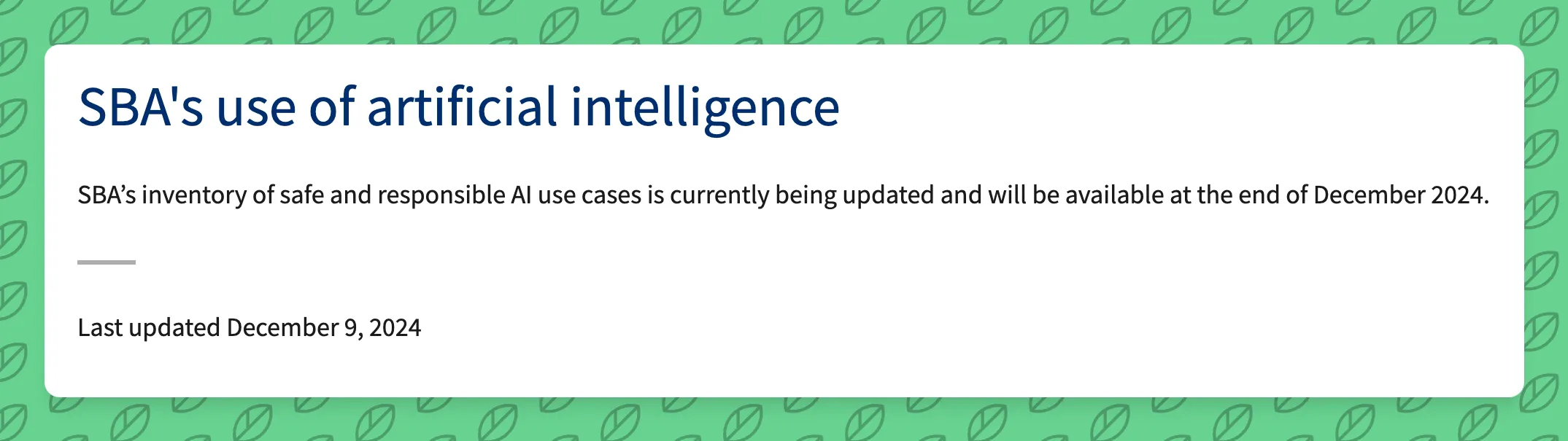
There’s also the matter of agencies that haven’t yet submitted their inventories. The data shows that while 41 agencies submitted, some notable ones like the Small Business Administration were still finalizing their submissions.
My take
Going from 710 to 2,133 reported AI use cases in a year is real movement - not just paper progress. But digging into the details, most of what’s counted is internal productivity work, not transformative citizen-facing services. That’s not surprising. Internal tools are lower-risk and easier to get approved.
The 206 extensions granted for risk management are the more telling number. Agencies are deploying faster than their governance frameworks can keep up. I’ve seen this pattern from the inside - it’s not negligence, it’s just that policy and technology move at very different speeds in government, for reasons that aren’t always wrong.
What would make this more useful
The big gap in the inventory is status clarity. “Initiated” and “Operation and Maintenance” tell very different stories, but you have to read carefully to find that. Better: a clear operational vs. in-development breakdown upfront.
Beyond that - impact data. Not “we implemented AI for X” but “this cut processing time by Y” or “accuracy improved to Z.” That’s what would actually help other agencies make informed bets. And for citizen-facing tools, any user feedback data at all would be useful.
Where this leaves things
The 2024 Federal AI Use Cases Inventory is worth reading if you work in this space. The volume of use cases is real, and the attention to rights and safety impact is more serious than I expected. Most of these are still in development, which is honest - a lot of government AI announcements skip that part.
The EO that required this inventory was rescinded in January 2025, so what happens to the reporting cadence is unclear. But the data already collected is still useful for understanding where agencies were placing their bets and what they were struggling with.
If you’re working on government AI and want to compare notes, reach out.
Further reading & resources
- 2024 Federal AI Use Cases Inventory on GitHub
- Former White House Executive Order on Safe, Secure, and Trustworthy AI (Note: This EO was rescinded on January 20, 2025)
- OMB Memorandum M-24-10 on Advancing Governance, Innovation, and Risk Management for Agency Use of AI
- NIST AI Risk Management Framework
Related Posts
- Reviewing the 2025 Federal AI Use Cases InventoryThe 2025 Federal AI Use Case Inventory dropped: 3,611 use cases across 56 agencies, up from 2,133 last year. Here's what I found digging into the numbers.6/1/2026
- Little AI Projects: Experiments at the Intersection of Government, Civic Tech, and ProductivityA roundup of small AI experiments I've been building - MCP servers, benefits navigators, policy engines, and local model fine-tuning - all exploring how AI can make government more accessible.3/12/2026
- AI Agent Identity Assurance: The NIST IAL/AAL CrosswalkNIST's IAL/AAL was built for humans. When AI agents act on your behalf, the assurance levels still apply - the mapping just changes.5/6/2026